
Nationwide cancer database
Basic statistical data
Basic statistic data for Poland in 2023
192,922 have been diagnosed,
96,925 of which occured in men and 95,997 in women.
What is the Polish National Cancer Registry?

1. What is a medical registry?
It is a population based registry, collecting data on new cancer cases in Poland. It is a unique source of epidemiological data on cancer incidence, that is collected according to standards, ensuring comparability with data from other countries.

2. What are the main tasks of the Polish National Cancer Registry?
Collecting, actualization and analysis of data on diagnosed cancer cases, necessary for implementation of public health tasks and public statistics. Moreover, epidemiological analyses, especially description of cancer incidence, assessment of changes over time, survival analysis and prognoses.

3. Population-based registry
Polish National Cancer Registry (PNCR) collects data from whole Poland and embraces whole country population. Data stored in KRN, as in population based registry, contain minimal range of information allowing for health state monitoring of Polish population with regard to cancer. Range of collected data is in accordance with guidelines of international organizations of cancer registries, that are operating at the World Health Organization and European Commission.

4. Site-specific registries
Site-specific registries are the new generation registries aiming at detailed surveillance of chosen cancers, e.g. hematological malignancies. Site-specific registries allow for precise assessment of particular therapies effectiveness, can support creating guidelines/standards of treatment, they are valuable complementary data source for research and medical interventions assessment.
How does e-KRN+ work?
The eKRN+ system allows for connecting all cancer registries in Poland into one coherent system. That enhances system capabilities and allows for consistent management of statistical information on every type of cancer.
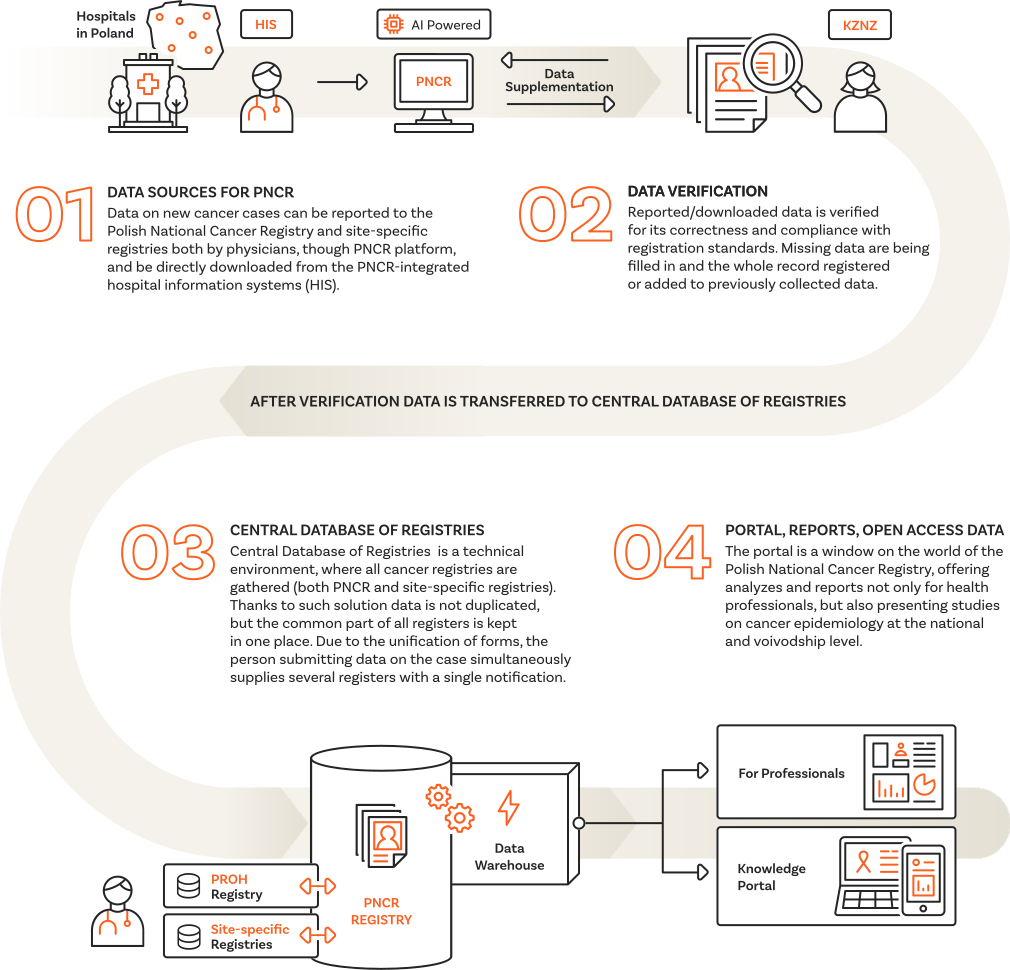
01. DATA SOURCES FOR E-KRN+
Data on new cancer cases can be reported to the National Cancer Registry and site-specific registries both by physicians, though e-KRN+ platform, and be directly downloaded from the KRN-integrated hospital information systems (HIS).
02. DATA VERIFICATION
Reported/downloaded data is verified for its correctness and compliance with registration standards. Missing data are being filled in and the whole record registered or added to previously collected data.
AFTER VERIFICATION DATA IS TRANSFERRED TO CENTRAL DATABASE OF REGISTRIES
03. CENTRAL DATABASE OF REGISTRIES
Central Database of Registries is a technical environment, where all cancer registries are gathered (both KRN and site-specific registries). Thanks to such solution data is not duplicated, but the common part of all registers is kept in one place. Due to the unification of forms, the person submitting data on the case simultaneously supplies several registers with a single notification.
04. PORTAL, REPORTS, OPEN ACCESS DATA
The portal is a window on the world of the National Cancer Registry, offering analyzes and reports not only for health professionals, but also presenting studies on cancer epidemiology at the national and voivodship level.
Infographic transcription
01. DATA SOURCES FOR E-KRN+
Data on new cancer cases can be reported to the National Cancer Registry and site-specific registries both by physicians, though e-KRN+ platform, and be directly downloaded from the KRN-integrated hospital information systems (HIS).
02. DATA VERIFICATION
Reported/downloaded data is verified for its correctness and compliance with registration standards. Missing data are being filled in and the whole record registered or added to previously collected data.
AFTER VERIFICATION DATA IS TRANSFERRED TO CENTRAL DATABASE OF REGISTRIES
03. CENTRAL DATABASE OF REGISTRIES
Central Database of Registries is a technical environment, where all cancer registries are gathered (both KRN and site-specific registries). Thanks to such solution data is not duplicated, but the common part of all registers is kept in one place. Due to the unification of forms, the person submitting data on the case simultaneously supplies several registers with a single notification.
04. PORTAL, REPORTS, OPEN ACCESS DATA
The portal is a window on the world of the National Cancer Registry, offering analyzes and reports not only for health professionals, but also presenting studies on cancer epidemiology at the national and voivodship level.

The e-KRN+ Team
Our mission
Good data - the basis for making the right decisions in oncology!
The registry collects data on cancer in Poland. On their basis, the risk of cancer in population and the effectiveness of public health interventions and national public health policy are assessed. High quality and completeness of data in the Polish National Cancer Registry are the basic condition for the implementation of the registry tasks.
The main tasks of The Polish National Cancer Registry are: to prepare epidemiological analises of cancer incidence in Poland, estimate the number of patients living with cancer (morbidity), and assess the effectiveness of cancer diagnosis and treatment through survival analysis. A permanent element of the analysis of data from the database of the Polish National Cancer Registry is the study of the population health status, its dynamics and correlation with socio-geographical measures.
The collected data deliver evidence to prepare guidelines for the cancer control strategy based on disease prognosis. The registry is an invaluable tool for monitoring the effectiveness of the national health policy (at all levels: prevention, screening, treatment). The tasks of the registry also include research on the relationship between disease and exposure to risk factors in geographical terms.